Enjoy Sri Lankan Safari

You can now advance book your safari to Yala including reserving your Ticket ... its top ten countries to visit in 2015 and yes, the island of Sri Lanka is on the list

Feel The Sri Lankan Culture

Sri Lanka is one of the few countries with a very vast and rich cultural diversity. The culture is itself very unique and thereby contributes to the Sri Lankan identity.

Sri Lanka for food lovers

If you want to get to know Sri Lankan cuisine, you're in for a treat. With influences from Arab traders, Malay navigators, Portuguese, Dutch and British colonists, and South Indian neighbours, you'll be captivated by some of the local dishes. Check out these delicious culinary experiences - as well as some classes so you can take the taste back home, and some essential etiquette tips.

Whale Watching

BLUE WHALES – the largest creatures on Earth – as well as fin whales, sei whales, sperm whales, orcas (killer whales), dolphins, flying fish, turtles, manta rays and whale sharks can all be seen a few miles off the South Coast of Sri Lanka.

A relaxed holiday

A relaxed holiday takes in much of the wonderful diversity of Sri Lanka, but with minimal travelling and the packing. Our consultants will talk through the options with you,

Saturday, April 4, 2015

12 Sri Lankan foods you must try

1. Fish ambul thiyal (sour fish curry)
As you'd expect from an island in the Indian Ocean, seafood plays an important role in Sri Lankan cuisine.
Fish ambul thiyal (sour fish curry) is one of the most beloved varieties of the many different fish curries available.
The fish -- usually something large and firm, such as tuna -- is cut into cubes, then sauteed in a blend of
spices including black pepper, cinnamon, turmeric, garlic, pandan leaves and curry leaves.
Perhaps the most important ingredient is dried goraka, a small fruit responsible for giving the fish a sour flavor.
Ambul thiyal is a dry curry dish, meaning all the ingredients are simmered with a small amount of water and cooked until the liquid reduces. This allows the spice mixture to coat each cube of fish.
Originating in southern Sri Lanka, it's available throughout the country at restaurants that serve curry, and is best eaten with rice.

2. Kottu (also, kottu roti)
Over the traffic and noise at a Sri Lankan market, you'll likely hear the clanking of metal on metal and know kottu isn't far away.
Kottu is Sri Lanka's hamburger -- everybody's favorite go-to fast food when craving something tasty and
greasy.
It resembles fried rice, except instead of rice, it's made with a type of roti known as godamba roti (a flat, crispy bread).
The roti is normally fried at the beginning of the day, piled into stacks and served as it's ordered.
When you place an order, the kottu chef will fry and chop the roti with a selection of ingredients you choose.
The result is a tasty mixture of salty pieces of fried dough, lightly spiced and extremely comforting.
Kottu is served with spicy curry sauce, which you can either use as a dip or pour over your entire plate.
Some of the most skilled kottu chefs compose their own unique songs, singing while they rhythmically clank their spatula and knives against the metal frying surface, slicing the roti with each clank.
3. Kukul mas curry (chicken curry)

Simple to make, chicken curry is a common household dish in Sri Lanka.
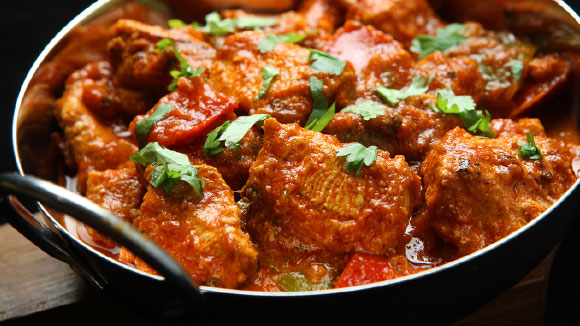
There are many variations depending on region and taste preferences.
Spices like fennel seeds, cardamom, cloves and cinnamon sticks are tempered in hot oil before being combined with chicken and spices like chili powder, curry powder, turmeric, pandan leaves, lemongrass and curry leaves.
Coconut milk contributes to the rich base of the curry gravy. Depending on the recipe, a puree of tomato is often included.
The chicken is stewed for an hour or so until the essence of the spices is infused into the chicken.
Most satisfying when served with hot rice and roti.
4. Parippu (dhal curry)
Parippu, or dhal curry, is the most common curry in all of Sri Lankan cuisine, a staple in any restaurant or household.
Masoor dhal (split red lentils) are first rinsed and boiled until soft.
In a separate pan, a number of fresh ingredients, such as onions, tomatoes and fresh green chilies, are sauteed and mixed with tempered spices like cumin seeds, turmeric, fenugreek, mustard seeds and curry leaves.
All the ingredients are combined and usually thickened with a splash of fresh coconut milk to give the dhal a rich flavor and creamy texture.
It goes with everything, but is perfect as a dipping gravy for a fresh roti or paratha.

5. Lamprais
Sri Lanka has been influenced by a diversity of cultures and one of the most evident is the Dutch Burgher community.
Lamprais, a word that combines the two Dutch words for "lump" and "rice," is a combination of meat, rice
and sambol chili sauce, wrapped into a banana leaf packet and steamed.
The rice is cooked with meat stock -- usually a combination of different meats like beef, pork or lamb -- that's infused with cardamom, clove and cinnamon.
A scoop of rice is placed in the center of a banana leaf, along with the mixed meat curry, two frikkadels (Dutch-style beef balls), blachan (a shrimp paste) and a starch or vegetable, usually either ash plantain or brinjals.
The package is folded into a parcel and steamed.
Since lamprais is a Burgher contribution to Sri Lankan cuisine, the meat is usually prepared with sweet spices like clove and cinnamon, recreating the flavor favored by the Dutch Burgher community.
Original recipes called for beef, pork and lamb, but chicken and eggs are often included in a modern lamprais packet. 

6. Hoppers (appa or appam) and string hoppers (indi appa or idiyappam)

Hoppers are the Sri Lankan answer to the pancake.
The batter is made from a slightly fermented concoction of rice flour, coconut milk, sometimes coconut water
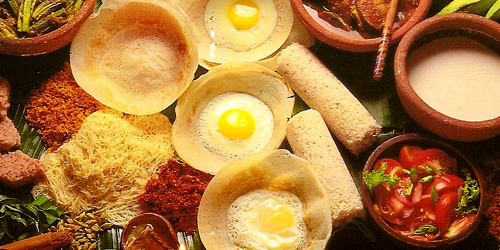
and a hint of sugar.
A ladle of batter is fried in a small wok and swirled around to even it out.
Hoppers can be sweet or savory, but one of the local favorites is egg hoppers. An egg is cracked into the bowl-shaped pancake, creating the Sri Lankan version of an "egg in the hole."
Egg hoppers are garnished with lunu miris, a sambol of onions, chilies, lemon juice and salt.
Unlike the runny batter used for hoppers, string hoppers are made from a much thicker dough.
The dough is squeezed through a string hopper maker, like a pasta press, to create thin strands of noodles, which are steamed.
String hoppers are normally eaten for breakfast or dinner with curries.

7. Polos (green jackfruit curry)

Jackfruit is consumed in a number of different stages of ripeness, from very ripe and sweet to green and starchy.
Polos is a Sri Lankan curry prepared with young green jackfruit.
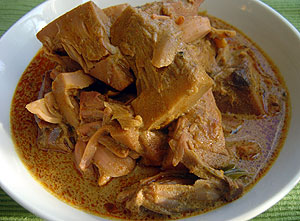
The fruit is sliced into bite-sized chunks and boiled until soft.
It's then cooked with onions, garlic, ginger and spices like mustard seeds, turmeric, chili powder, roasted curry powder, pandan leaves and curry leaf sprigs.
The final step is to add coconut milk and simmer to reduce most of the liquid, leaving all the beautiful flavors within the cubes of jackfruit.
Jackfruit has a starchy texture, somewhat similar to cassava or potato.
Polos is a standard dish available at most Sri Lankan curry restaurants.

8. Wambatu moju (eggplant/brinjals pickle)

Served mostly with rice and curries, wambatu moju is an extremely flavorful candied eggplant (brinjals)
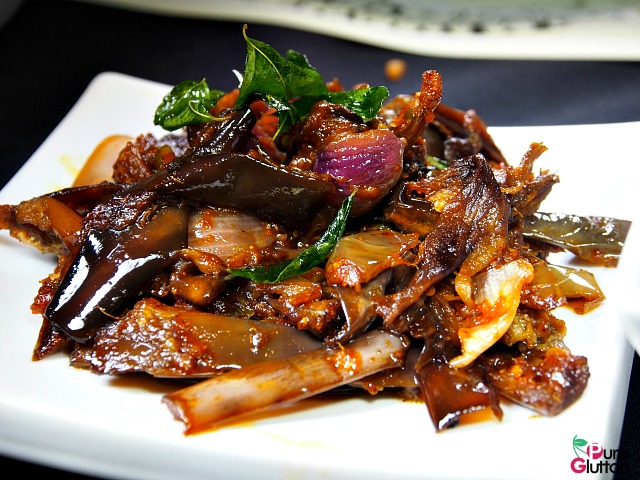
pickle.
The eggplant -- usually the purple-skinned, long and slender variety -- is cut into bite-sized wedges and deep fried, giving the eggplant a crispy texture with a soft and silky interior.
It's then caramelized with a spoon of sugar, vinegar, red onions, green chilies, mustard seeds, chili powder and a hint of turmeric powder until the color turns almost black.
Take a bite and the soft and juicy texture of the eggplant should melt in your mouth -- the slightly sweet, sour and salty contrast is absolutely sensational. 

9. Gotu kola sambol (pennywort salad)

Gotu kola, or Asiatic pennywort, is a popular medicinal herb. One of the most readily available green vegetable dishes in Sri Lanka is gotu kola sambol.
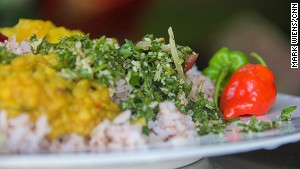
Gotu kola (known in English as Asiatic pennywort) is a medicinal herb in Asia.
It's shredded into slivers, then combined with shallots, tomatoes, fresh grated coconut and chili and seasoned with a dressing of salt, pepper and lemon juice.
Sambol is a term used in Sri Lanka for ingredients that are combined and eaten raw, sometimes more of a chili sauce and sometimes more of a salad, like gotu kola sambol.
Gotu kola has a powerful, herbaceous flavor similar to kale, making it an extremely fresh and crisp dish.
It's typically a side dish served with curry and rice.

10. Kiribath with lunu miris

Kiribath is a special type of rice, cooked with thick coconut milk and often served during special or auspicious occasions, such as Sinhalese New Year.
There are a few versions of kiribath, but the basic procedure is to start by boiling a pot of rice.
Before the rice finishes cooking, add coconut milk and a pinch of salt. The coconut milk makes the rice creamy and rich and helps it form a sticky consistency.
Once the rice is finished cooking, it's cut into wedges and served like slices of cake.
Kiribath can be eaten along with a number of different Sri Lankan dishes, often either sweetened with jaggery or consumed salty with chili sauce or curry.
One of the most common ways to garnish kiribath is with lunu miris, a sambol chili sauce made from red chilies, onions, lemon juice, salt and sometimes dry Maldive fish, all ground into a paste using a stone mortar and pestle.

11. Pol Sambol (coconut relish)

In a country in which the coconut is of supreme importance, there's one Sri Lankan side dish that pays fitting
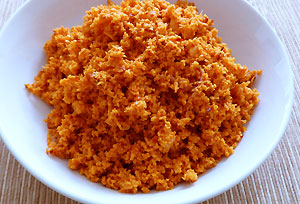
tribute.
Pol sambol, which might also be called fresh coconut relish, is a simple blend of finely grated coconut, red onions, dried whole chilies or chili powder, lime juice, salt and Maldive fish (if available).
The ingredients are diced or ground, then combined in a bowl.
In Sri Lanka, pol sambol is used as a garnish or side dish for everything and anything.
It goes well with rice and curry, pol roti (coconut roti), a hot paratha, string hoppers or even just scooped up with slices of bread.
If you love coconut, there's no better garnish in the world.

12. Wood apple

It wouldn't be a Sri Lankan food discussion without wood apple.
The wood apple is a Southeast Asian fruit about the size of a de-husked coconut. It also has just as hard of a shell, and a pungent, almost blue cheese aroma.
Walking through a market in Sri Lanka your nose will detect it long before your eyes do.
Inside the shell is a dark brown paste that resembles something between tamarind pulp and fermented raisins.
Wood apple can be eaten directly out of the shell, but one of the most popular ways to eat (or drink) it throughout Sri Lanka is in a thick smoothie, known as wood apple juice.
The fruit is blended with jaggery (or sugar) and water to smooth it out.
It has a unique sour and sweet flavor.
Mention that you love wood apple to any Sri Lankan you meet, and they probably won't be able to hold back a knowing smile.

Diving and snorkeling sri lanka

Sri Lanka is globally renowned for its diving and snorkeling tours. As beautiful as Sri Lanka is on land, it is equally matched with its spectacular underwater scenery. Beneath the waters of the Indian Ocean lies a separate world of tropical fish, coloured coral and mysterious shipwrecks.

           The southern coast of Sri Lanka is especially popular as it provides breathtaking underwater tours for all those who want to grab a slice of Sri Lanka under the sea. Located 5 to 9 degrees north of the equator means that the Sri Lanka seas are perennially warm and when in season they remain at an inviting temperature of around 27C. Sea conditions are governed by the two monsoons – the northeast and southwest- permitting calm seas and clear waters along the south and western coastline from November to April and from April to October along the eastern coast of the island. Diving and snorkeling in Sri Lanka is all the more interesting because of the different types of reef that is found in the seas around the island. There are sandstone platforms, coral banks, boulders and rock cliffs that are found both close as well as far away from the shore.


HIKKADUWA

With its impressive coral reefs and abundance of tropical fish, HIKKADUWA is recognised as one of the
best places for Snorkelling and diving on the Southwest coast (in the southwest season of November to April). With a reputed and long-running diving school located in the town itself, PADI diving instructors are available throughout the season for training and certification as well as leading more experienced divers in some of the country's best ship wreck and reef dives.

KALPITIYA

Despite its natural beauty, the western peninsular area of KALPITIYA in the Puttalam district of Sri Lanka is remarkably untouched by tourism. For keen scuba divers and snorkellers, the largest coral reef in Sri Lanka (‘Bar reef') is only an hour's boat trip from Kalpitiya. This beautiful reef is home to an incredible variety of
tropical fish as well as offering sighting of manta rays, reef sharks and the occasional turtle! Diving and Snorkelling are not possible during the southwest monsoon period (May to November). The best times are therefore between late November and early May. Transportation to dive/Snorkelling sites is by a fibre glass dinghy of 25 horse power engine. For the more serious divers who want more detailed information on the area, please refer to Nautical Map 1586 (Pamban to Cape Cormorin). The underwater currents in the seas off Kalpitiya are generally not strong, but are influenced by small tide changes of two high water and two low water tides. The underwater temperature is approximately 75°F so no wetsuits are required (but thin wetsuits could be worn to protect from any bruising from the coral).

KIRINDA

On the southeast coast, approximately 10km south of Tissa, lies the pretty village of KIRINDA. The village itself boasts a superb beach and an interesting Buddhist shrine on the rocks. However, it is best known as a
base from which to experience some excellent diving at the famous ‘Great Basses' wreck and the Great and Little Basses reefs (southeast of Kirinda). The famous Arthur C Clarke also put Kirinda on the map when he used it as his base for his diving exploration in order to write his book ‘The Treasure of the Reef'. A particularly unique feature of the Great Basses is the light-house that was actually constructed on the reef in 1860.

WELIGAMA

Also known as ‘sandy village' WELIGAMA is located approximately 30 km east of Galle. As well as having an attractive sandy bay, this fishing town is also an ideal base for SNORKELLING and DIVING, with many
fascinating sites to explore. For those who'd rather stay above the surface of the water, catarmaran rides are a pleasant way to venture out on the sea. You can also go out further to the deeper waters to see a variety of dolphins and sharks. Possible Period Early November to Mid April.


TRINCOMALEE

TRINCOMALEE (more commonly known as ‘Trinco') is a prime eco tourism venue which is located on the northeast coast of Sri Lanka and offers some of the country's most attractive beaches such as ‘Uppuveli' and ‘Nilaveli'. Fine white-sand and crystal clear water provides an irresistible combination that won't fail to
disappoint any visitor who loves the beach! Snorkelling around the famous Pigeon island just off Nilaveli beach is widely recognised to be a ‘must-do' activity during a stay in Trinco.

Tuesday, January 13, 2015

Anuradhapura


Anu-radha-pura Kingdom lasted one thousand and five hundred years from 380BC. This city is home to many of the earliest grandest monuments of Sri Lanka. A popular destination of Sinhalese Buddhist's prilgimages because of its many ancient Buddhist monuments.

Anuradhapura has been made royal capital by the king Pandukabhaya in 380 BC. It remained residence and royal capital for 119 successive Singhalese kings till the year 1000 AD when it was abandoned and the capital moved to Polonnaruwa. You will see some of the most famous as well as the tallest dagoba of Sri Lanka, remains from palaces, temples, monasteries, ceremonial baths and the temple of the holy Bo-tree. This tree was grown from a sapling of the very tree under which more than 2500 years ago the Buddha found enlightenment.
 
Aukana Buddha
The 13 meter high statue carved out of solid granite, goes back to the 5th century, to the reign of King Dathusena. (about 50km south of Anuradhapura) On a rainy day, it is said, that one can see droplets of water falling off the tip of the statue's nose hitting the ground exactly between the toes.- a testament to the architectural accuracy of the sculptor. The brick enclosure around and above was built recently to protect it from weather.


Guard stone at Thuparama
Thuparama Temple
Thuparama is considered to be the oldest dagoba in Sri Lanka and is believed to enshrine the collar bone relic of Lord Buddha. The guard stones like these are generally found in pairs at the entrance to temples, palaces and other revered sites.


Isurumuniya Lovers
Isurumuniya temple built in the 3rd century B.C. is noted for its rock carvings. The best known among these is the "Lovers". Many a poet and song writer has taken inspiration from this carving to write their masterpieces. It is believed that the carving may represent Saliya the son of the great king Dutugamunu and the low-caste maiden whom he loved.
Ruwanveli Seya
Popularly regarded as the greatest, and certainly the most popular among the Buddhists, of the stupas at Anuradhapura, Ruwanveli Seya, is the pride of the Great Emperor Dutugamunu. Raised in the 2nd century B.C. this dagoba is supposed to have the perfect water bubble shape. Among the many statues in the courtyard there is one that is of a larger-than-life man. This is considered to be the king himself watching his work from a respectable distance.
ElephantWall
Abhayagiri Stupa and Monastery
Abhayagiri is the largest monastery complex in the Anuradhapura kingdom. Founded in the second century BC by king Valagamba(also known as Vattagamini Abhaya) was an international institution by the first century AD.
Covering an area of 200ha the monastery include full components of a Buddhist temple as well as other buildings. The stupa at Abhayagiri is 108m tall and one of the tallest brick buildings of the ancient world.
The finest Buddha sculpture in Sri Lanka the Samadhi Statue (3- century AD) is among its many fine stone carvings.
Ruwanweli Seya
Museum
The Folk Museum has a collection of artefacts illustrative of the rural life of the North Central Province and the near by Archaeological Museum display what is excavated from Abhayagiri temple explorations.
Ritigala

A beautifully paved footpath, several elevated platforms, ruins of an old hospital and remains of a terraced pond are what is unearthed at this 180 BC Buddhist monastery at the foothill of 600m high Ritigala Rock. Dating back to around 350 B.C is one of the oldest historical places mentioned in the ancient chronicles. (about 50km south east of Anuradhapura)
 
Mihintale
The temple of Mihintale is where Thero Mahinda, the son of Great Indian Emperor Asoka introduced Buddihism to the king of Sri Lanka Thissa.
Mahinda's sister Theri Sangamitta carried a off shoot of the the ', the holy Bo tree that gave shelter to Buddha to attain Nibbana. Sri Maha Bodhi' The Bo tree was planted at Anuradhapura, where it still grows as the oldest tree with a recorded history in the world.
Jethawana Monastery
The monastery complex is built where it is believed to be the cremation grounds of the Mahinda Thera who introduced Buddhism to Sri Lanka. Founded by King Mahasena (276-303AD) the stupa at 120m high was the third tallest monument in the world at the time of the fall of Roman Empire.
Distances Other Cities in km
.
Colombo 206
Habarana 57
Polonnaruwa 101
Kandy 138
Dambulla 66
Sigiriya 80

Yala National Park

YALA NATIONAL PARK, one of Sri Lanka 's premier eco tourism destinations, lies 24km northeast of Tissamaharama and 290km from Colombo on the southeast coast of Sri Lanka, spanning a vast 97,878 hectares over the Southern and Uva Provinces.

The vegetation in the park comprises predominantly of semi-arid thorny scrub, interspersed with pockets of fairly dense secondary forest. Small patches of mangrove vegetation also occur along the coastal lagoons.
The park is renowned for the variety of its Wildlife (most notably its many elephants) and its fine coastline (with associated coral reefs). It also boasts a large number of important cultural ruins, bearing testimony to earlier civilizations and indicating that much of the area used to be populated and well developed.


Sigiriya (The Lion Rock)

Sigiriya The Palace & Fortress in The Sky

Sigiriya, the spectacular 'Lion rock' fortress, stands majestically overlooking the luscious green jungle surroundings, and is one of Sri Lanka's major attractions.
SigiriyaThis was built by King Kasyapa, a son of King Dhatusena, by a palace consort. As legend goes, King Dhatusena was overthrown and walled in, alive by Kasyapa in 473 AD. Mogallana, Dhatusena's son by the true queen fled to India, vowing revenge.
Kasyapa fearing an invasion built this impregnable fortress at Sigiriya.
When the invasion finally came in 491, Kasyapa rode out to battle in his war elephant.In an attempt to out-flank his half-brother, Kasyapa took a wrong turn, where his elephant got stuck in the mud. His soldiers, thinking Kasyapa was retreating fled abandoning him, and he took his own life.
Sigiriya later became a monastic refuge, but eventually fell into disrepair.


Sigiriya water gardenWater Gardens

The beautifully and elaborately landscaped water gardens, contain a complex network of underground water distribution system, which provides water to the Royal baths, the many little moated islands & fountains, some fountains still work during the rainy season! A superb view of the Gardens could be had from halfway up the rock.


Sigiriya frescoesFrescoes - The Sigiriya Damsels

About halfway up the rock is a sheltered gallery of frescoes painted on the sheer rock face. The 'Heavenly Maidens' are similar in style to the paintings of Ajantha in India. Some of them are still in remarkably good condition. Only 22 out of an estimated 500 pictures now remain. Flash photography is not allowed at this site.


Sigiriya mirror wallThe Mirror Wall with Graffiti

Beyond the fresco gallery, the pathway circles the the sheer face of the rock, and is protected by a 3m high wall. This wall was coated with a mirror-smooth glaze, in which visitors over 1000 years ago noted their impressions of the women in the gallery above. The graffiti was mostly inscribed between the 7th and 11th Century AD. 685 of them have been deciphered and published. The graffiti are a great source for the scholars to study the development of the Sinhala language and script.


Sigiriya Lion platformLion Platform

The Northern end of the rock the pathway emerges to a platform, from which the rock derives its name Sigiriya (the Lion Rock). At one time a gigantic brick lion sat at the end of the rock, and the final ascent to the summit was between the lions paws and into it's mouth! Today the lion has disappeared, only the paws and the first steps are visible.


The Summit

Sigiriya foundations
Covering an area of around 1.6 hectares, the remains of the foundations show that the summit would have been completely covered with buildings. The design, layout and magnificent views that it still enjoys to this day, suggest Sigiriya would have been more of a royal palace of pleasure than a fortress. A pond scooped out of solid rock measuring 27m x 21m, looks like a modern rooftop pool. A smooth slab of flat stone, often referred to as the kings stone throne, faces the rising sun.
 

Nuwala Eliya ( The Little England )

Nuwara Eliya is high up in the mountains of central Sri Lanka.


The drive to this area is full of winding roads with beautiful scenery, rolling green hills and lots of tea plantations.  The climate is much different than the coastal region with temperatures getting quite cool in the evening.

A journey to this area is highly recommended 


Places of interest in and around Nuwara Eliya


Gregory's Lake - Nuwara EliyaNuwara Eliya Post office

This lake was fashioned under orders of British Governor Sir William Gregory in 1873. A boat yard now allows visitors to go boating and rowing.

Hakgala Botanical Gardens

HakgalaThe Gardens was firs established in 1861 under the curatorship of three British of the same name - William Nock, JK Nock and JJ Nock. It lies under the Hakgala Peak, between 5000 - 6000 feet in elevation - the highest set Botanic Gardens in the world. It boasts 100 year old Monetary Cypress trees from California, Japanese Cedars, Himalayan Pines and English Oak.


Horton Plains

Horton PlainsHorton Plains is a National Park and the highest plateau in the island consisting of grassland interspersed with patches of forest, with some unusual high altitude vegetation. The Plains are a beautiful, silent, strange world with some excellent walks.
The most stunning place is the World's End, where the southern Horton Plains suddenly ends, and drops off to nearly 700 Metres, which is an awesome sight indeed. This is a favourite place for trekkers, as there are plenty of soft and hard trails.

Laksapana Falls

Devon FallsLaksapana Falls rise from the Laksapana estate and plunges into the Maskeliya Oya via Maoussakelle. Viewing this fall is easy if you camp down at Upper Glencairn, Dick oya.


Lover's Leap - Nuwara Eliya

This is off the Nuwara Eliya - Kandapola Road. The waters are taken to brew the famous Nuwara Eliya Beer. It is said how an eloping couple, pursued by an irate father, threw themselves over the falls.

Devon Falls

Devon Falls drops 97 metres and is named after Devon, a pioneer coffee planter. It is 6 Km west of
Thalawakelle and there is a special parking and viewing spot at the 20th mile post.


Oliphant Estate - Nuwara Eliya

A visit to this estate, entrance from the road at the Ramboda end of Nuwara Eliya, is significant because it was here that the first thirty tea plants sent from China to Sri Lanka were planted by Mr. Laurence Oliphant, increasing his tea acreage to 100 acres.


The Ceylon Breweries - Nuwara Eliya

The brewing of beer was started in Nuwara Eliya by Sir Samuel Baker in 1881 at Lover's Leap. It is an interesting visit, for the brewery is one of the finest in the island. It's been in business since 1884.

Adam's Peak - The Pilgrim Path

Nuwaraeliya - HattonThis is through Gampola and Ginigathhena and you will find the story of this old path carved on two rocks off the 28th milestone on the Nawalapitiya - Ambagamuwa road. The spot is called Akuruketupana and the inscription dates to around 1100AD. Today there are four other roads to the peak, the shortest being via Maskeliya and the most popular. Other roads are on the Sabaragamuwa side.


Nuwara EliyaThe Nissangala Lena on the road to Adam's Peak

This is believed the cave in the mountainside, where King Keerthi Sri Nissanka buried a great treasure, including his regalia. It is only after one passes this cave and enters the forest that one comes to the Sita Gangula, a holy river of ice cold water, where pilgrims bathe and put on white garments, before continuing their journey to the peak.